I vaguely knew the word rhetoric. I'd heard of ethos, pathos, logos, and how the Greek philosopher Aristotle coined the term. I understood how emotional connection was important in winning an argument, as much as logic or your own voice of authority.
But I didn't know there were specific techniques beyond that, or that I was using them in my poetry.
Until recently, that is, when I saw a breakdown online of rhetorical techniques used in a recent UN speech. And that got me wondering: I'm using these techniques instinctively, but wouldn't it be great to understand and spot them, and maybe overlay them onto my own poetry?
And so rhetoric support was born in Spokenword. You can review rhetorical techniques within the app and assign them to your poems. It helps you hone your craft, moving from instinct to deliberate choice.
Twelve Techniques
I settled on twelve. Not because there are only twelve. Classical rhetoric has over two hundred named figures. But these are the ones that matter most when you're performing poetry on stage.
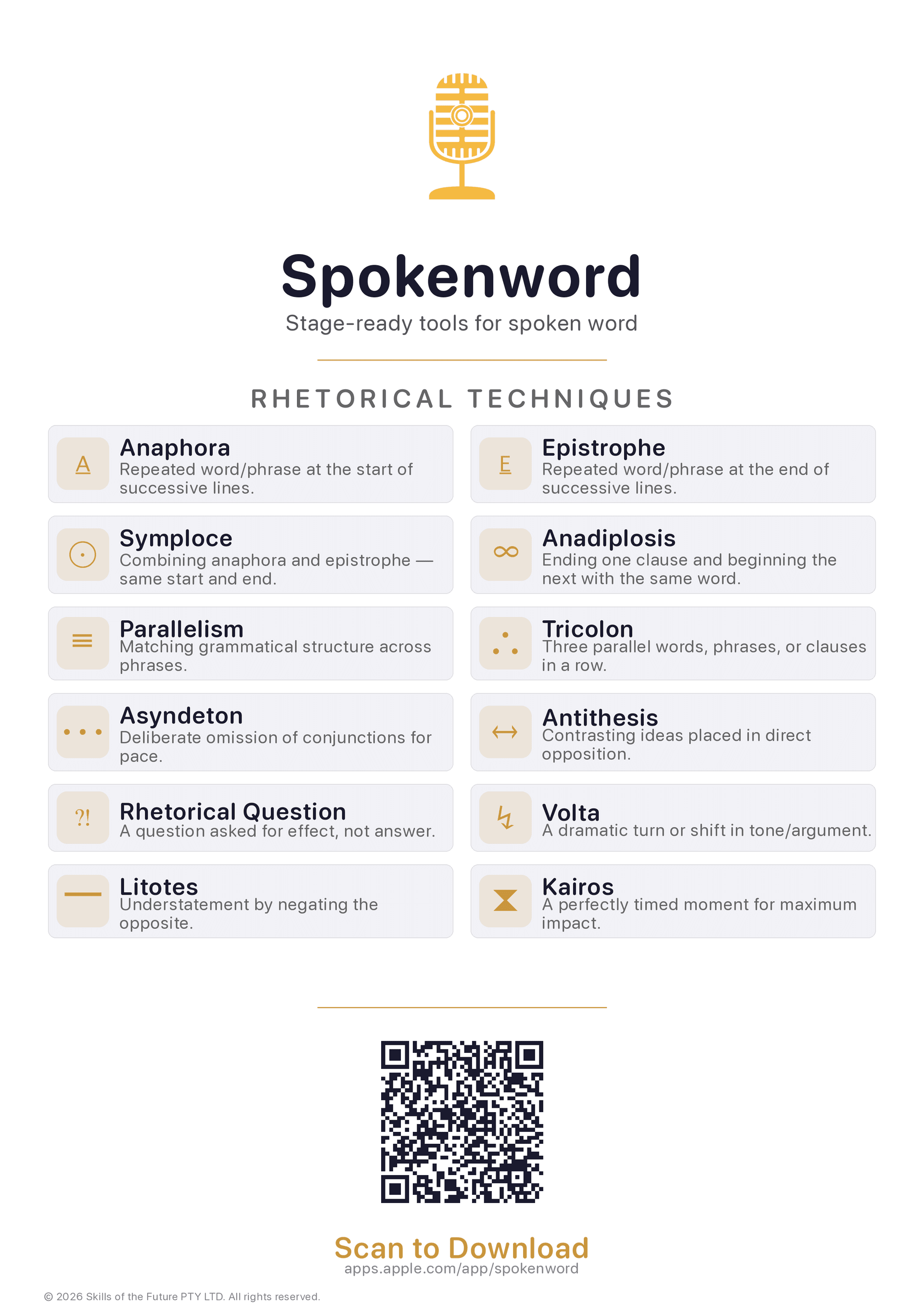
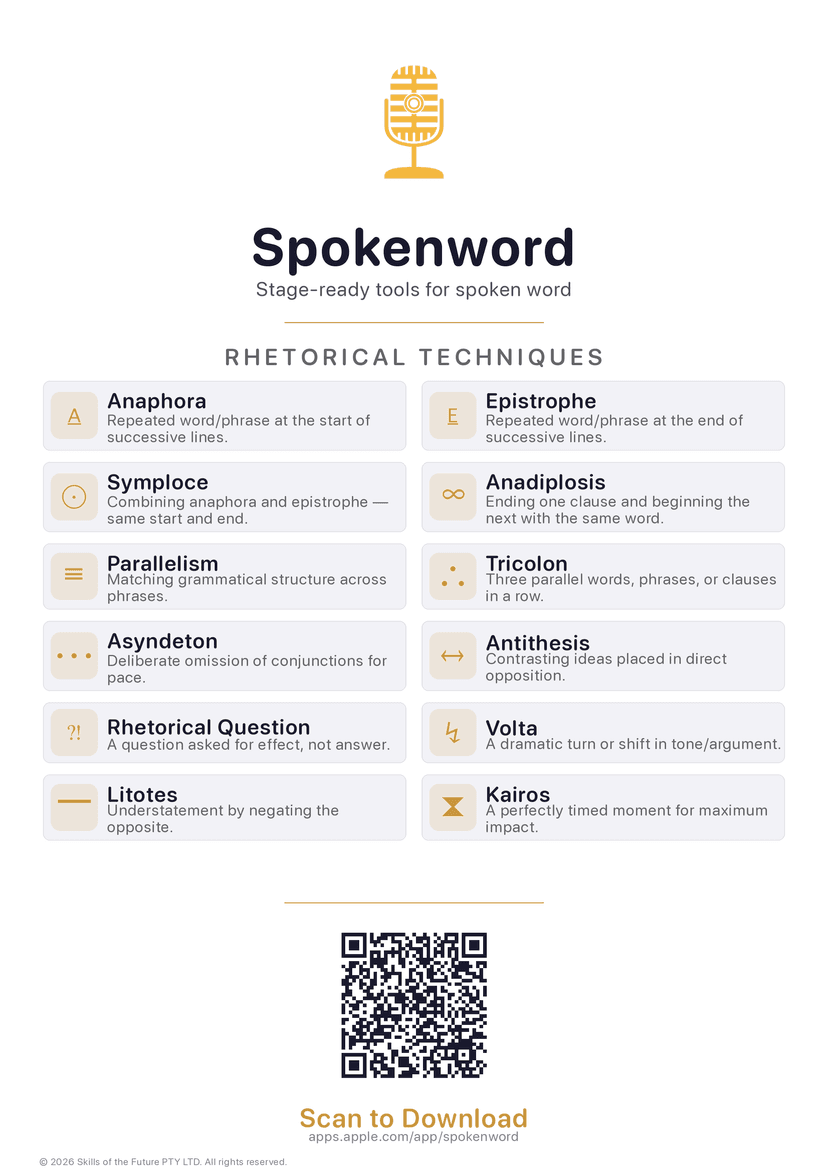
The twelve rhetorical techniques supported in Spokenword.

Anaphora
Repeated word at the start of successive lines

Epistrophe
Repeated word at the end of successive lines

Symploce
Combining anaphora and epistrophe

Anadiplosis
Ending one clause and beginning the next with the same word

Parallelism
Matching grammatical structure across phrases

Tricolon
Three parallel words, phrases, or clauses in a row

Asyndeton
Deliberate omission of conjunctions for pace

Antithesis
Contrasting ideas placed in direct opposition

Rhetorical Question
A question asked for effect, not answer

Volta
A dramatic turn or shift in tone

Litotes
Understatement by negating the opposite

Kairos
A precisely timed moment for maximum impact
What It Looks Like in Practice
Let me walk you through an example. Shakespeare's Sonnet 130, the one that starts “My mistress' eyes are nothing like the sun.” Fourteen lines. Four techniques.
Click a technique to highlight its lines
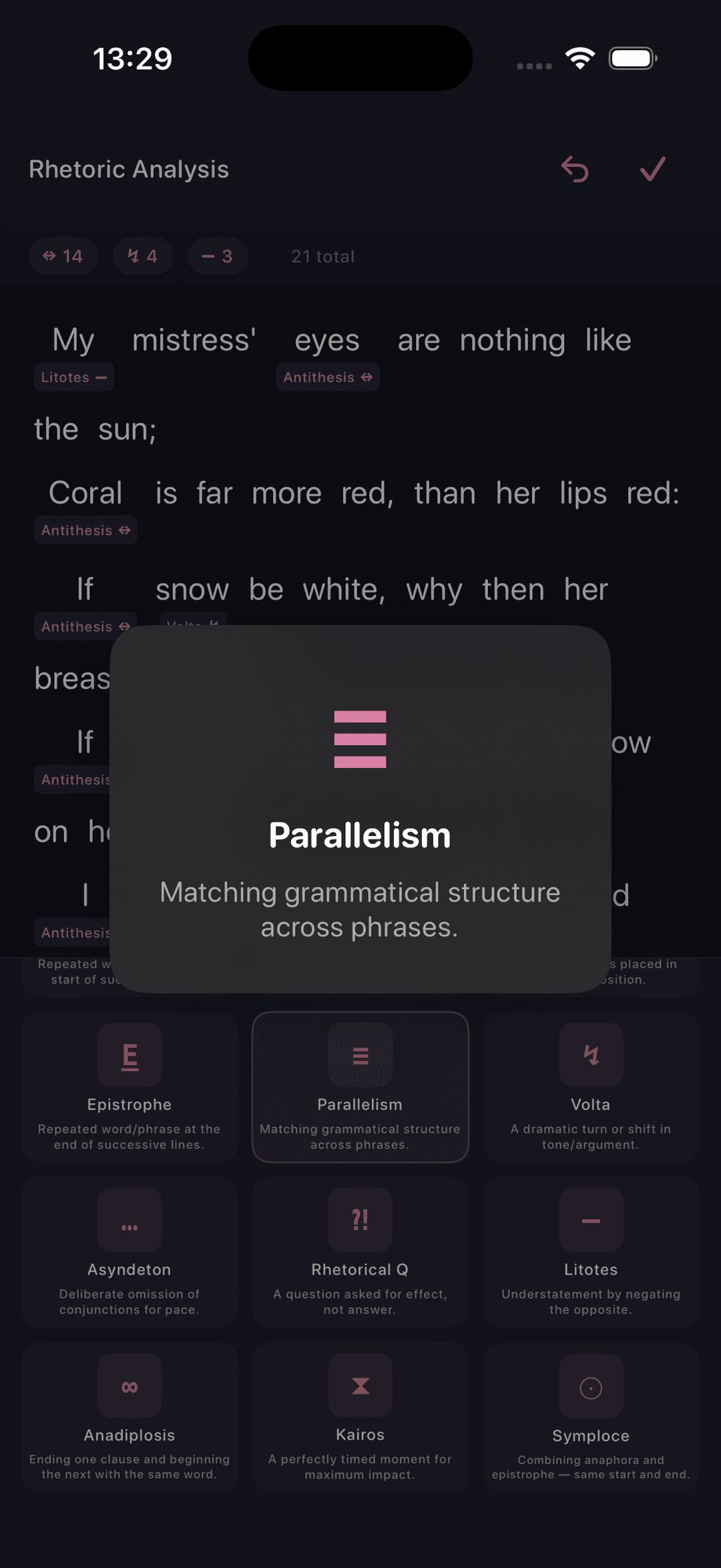
Sonnet 130
William Shakespeare
My mistress' eyes are nothing like the sun;
Coral is far more red, than her lips red:
If snow be white, why then her breasts are dun;
If hairs be wires, black wires grow on her head.
I have seen roses damask'd, red and white,
But no such roses see I in her cheeks;
And in some perfumes is there more delight
Than in the breath that from my mistress reeks.
I love to hear her speak, yet well I know
That music hath a far more pleasing sound:
I grant I never saw a goddess go;
My mistress, when she walks, treads on the ground:
And yet by heaven, I think my love as rare,
As any she belied with false compare.
“You can review rhetorical techniques within the app and assign them to your poems. It helps you hone your craft, moving from instinct to deliberate choice.”
What's Next
There's great analytical support to help learners and poets alike hopefully coming soon. Can't say much yet, but I think it will be a wonderful addition if I can successfully pass testing.
Spokenword helps you see the rhetoric you're already using, and start deploying it deliberately.
This is the second in a series. The first post: I'm a slam poet. I built an app.