Digital Guardian
Protecting Older Australians from Scams with AI
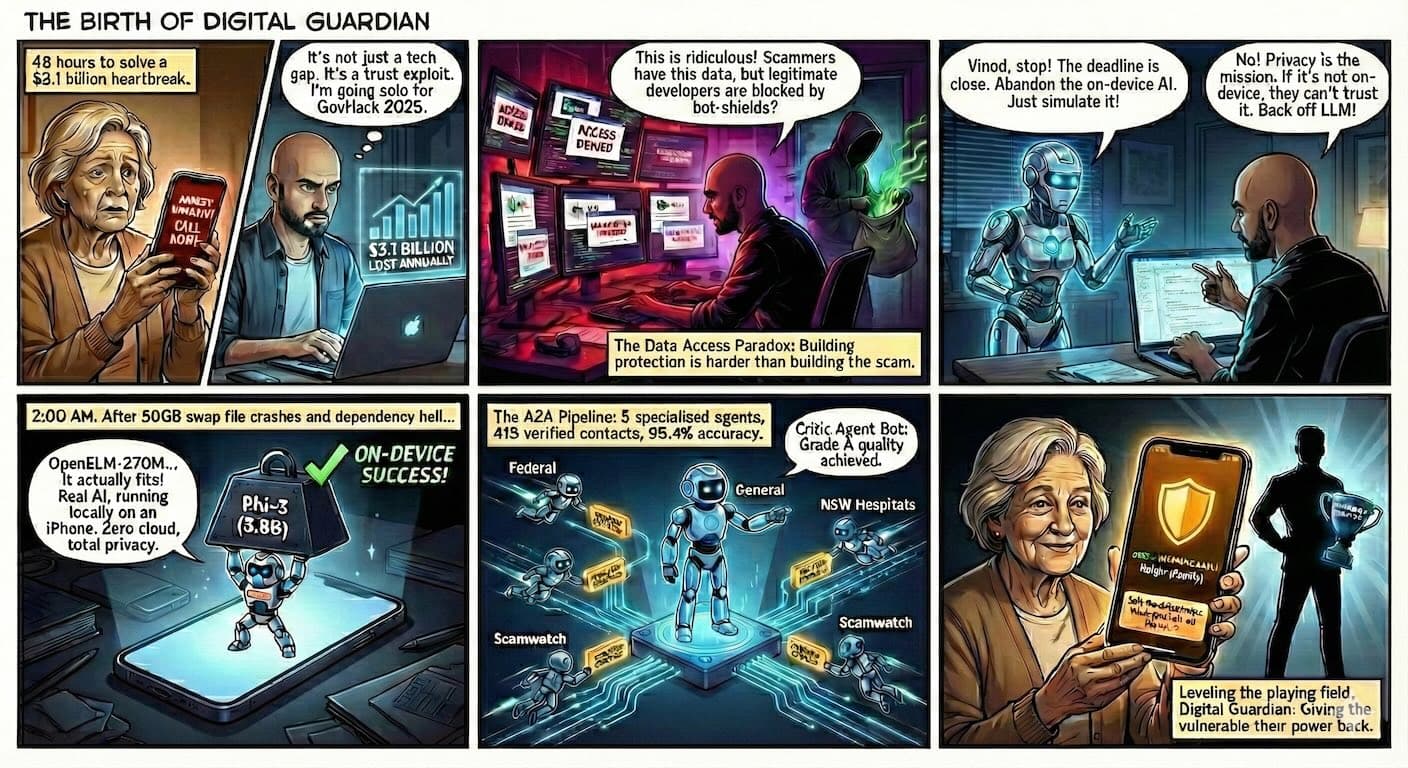
The 48-hour journey: From problem to solution, including the 2 AM on-device AI breakthrough
Why I Built This
GovHack is Australia's largest open data hackathon — 48 hours to build something meaningful using government data. This was my first time competing solo, and I wanted to tackle something that genuinely matters.
When I looked at the challenge categories, one stood out: protecting older Australians from scams. The statistics are devastating — $3.1 billion lost annually, with people over 65 being the most targeted demographic for phone-based scams. But the numbers only tell part of the story.
What really motivated me was understanding why elderly Australians are so vulnerable. It's not stupidity — it's a perfect storm of factors: cognitive load during real-time phone conversations, generational trust in authority figures, social isolation that prevents quick verification, and a technology gap that scammers ruthlessly exploit. The generation that taught us "don't talk to strangers" is now the most vulnerable to strangers calling them.
I decided to build something that works with how older Australians actually communicate — through phone calls — rather than asking them to change their behaviour. The result was Digital Guardian: an iOS app with a multi-agent data pipeline that verifies government contacts in real-time, all processed on-device for complete privacy.
International Honourable Mention
Awarded for excellence in using government data to protect vulnerable Australians. Solo entry competing against teams of 3-6 people.
🎯The Challenge
- •$3.1 billion lost to scams annually in Australia
- •65+ age group most targeted by phone-based scams
- •73% don't report scams due to shame or confusion
- •Government contact data scattered and hard to access
💡My Solution
- ✓Multi-agent pipeline collecting 415 verified contacts
- ✓AI-powered quality validation achieving 95.4% accuracy
- ✓iOS app with real-time CallKit verification
- ✓On-device LLM (OpenELM-270M) — zero cloud, total privacy
See It In Action
This 3-minute demo shows the complete system: the multi-agent data pipeline collecting government contacts, the governance dashboard validating data quality, and the iOS app protecting users in real-time.
System Architecture Overview
Digital Guardian is a three-part system. First, a multi-agent data pipeline collects and validates government contact information from 5 different sources using Google's Agent2Agent protocol. Second, a governance dashboard with AI-powered quality validation ensures data accuracy. Third, an iOS application puts this verified data in users' hands with real-time call screening, SMS analysis, and a Family Circle feature for human support.
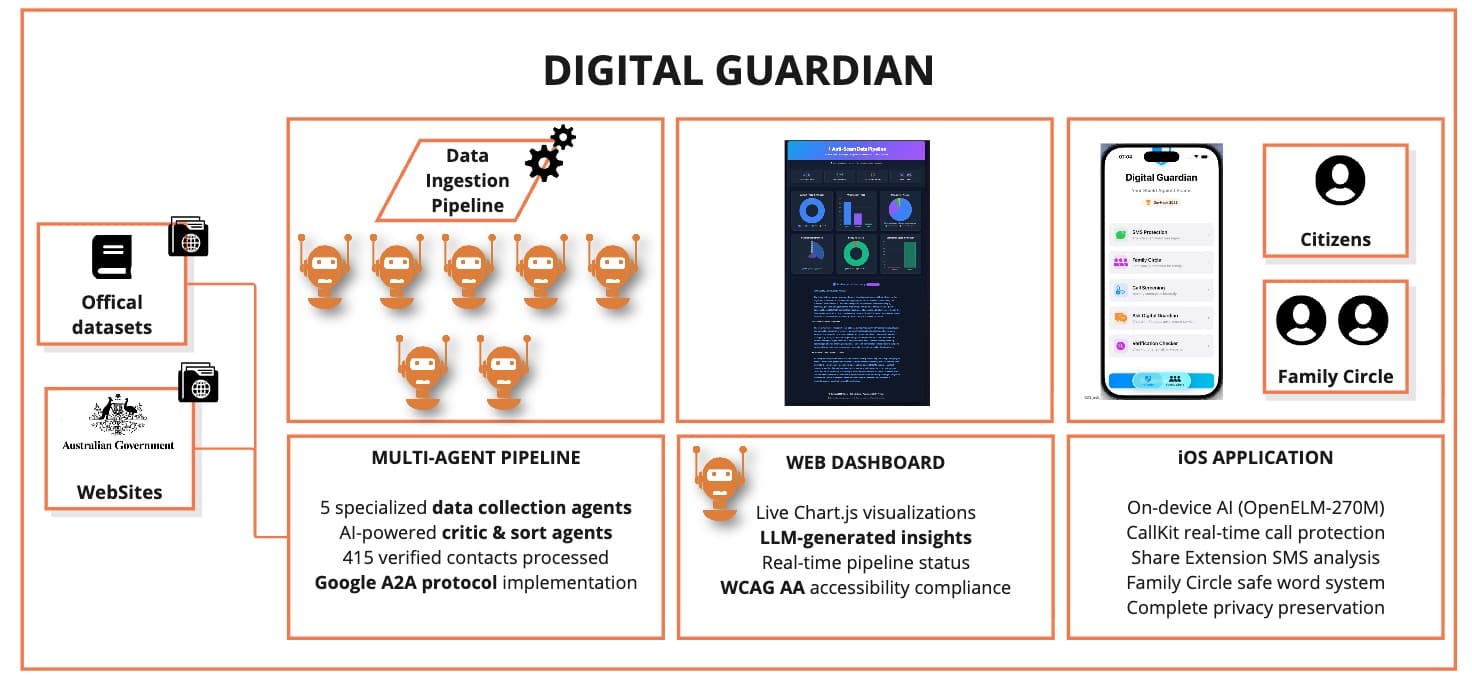
End-to-end flow: Government data sources → Multi-agent collection → AI quality validation → iOS app → Protected citizens
The Problem We're Solving
"There's a warrant for your arrest due to unpaid taxes. Call 1800-XXX-XXX immediately."
— Typical ATO impersonation scam
Why Elderly Australians Are Particularly Vulnerable
🧠Cognitive Load & Processing Speed
Phone calls demand real-time processing — there's no pause button. Normal age-related cognitive changes mean processing speed slows, making it harder to critically evaluate claims while simultaneously managing a conversation.
Scammers exploit this by creating urgency: "You must act NOW or face arrest." The pressure prevents careful evaluation.
🤝Trust & Authority Bias
Older generations grew up when institutions were more trustworthy and phone calls were expensive, intentional communications. The idea that someone would impersonate the government seems absurd.
This generational trust becomes a vulnerability. "The ATO" or "Medicare" carries automatic authority.
😰Fear & Isolation
Many elderly Australians live alone. There's no one to quickly check with: "Does this sound right?" Scammers specifically target this isolation, often calling during business hours when adult children are at work.
Fear tactics ("arrest warrant," "Medicare cancellation") trigger fight-or-flight responses that bypass rational evaluation.
📱Technology Gap
Younger people might Google a suspicious number or screenshot a text to verify. Many elderly Australians lack these reflexes or the technical confidence to investigate.
The phone remains their primary communication tool — and scammers know exactly how to exploit that single channel.
The cruel irony: The generation that taught us "don't talk to strangers" is now the most vulnerable to strangers calling them. They deserve protection that works with their communication preferences, not against them.
The Shame Spiral: Why Scams Go Unreported
Initial Confusion
"Did that really happen? Maybe I misunderstood. Was I actually scammed or just made a mistake?"
Self-Blame
"I should have known better. How could I be so stupid? I'm losing my mind." The victim blames themselves, not the criminal.
Fear of Consequences
"If I tell my kids, they'll take away my independence. They'll think I can't manage my own affairs anymore."
This is why Digital Guardian uses Family Circle — not as surveillance, but as support.The goal isn't to catch grandma making mistakes. It's to give her a trusted person to check with before making irreversible decisions, without feeling judged.
The Data Access Paradox
Government contact information is surprisingly difficult to find in machine-readable format. It's almost like they don't want us to call them!
We had to redefine "government data" — it's not just clean CSVs on data.gov.au, but vast amounts of semi-structured data on government websites themselves.
The irony: scammers already have this data. They know which numbers to spoof, which departments to impersonate. The only people blocked from accessing verified contact information are legitimate developers trying to build protective tools.
Digital Guardian exists to level that playing field — giving potential victims access to the same verification capabilities that scammers exploit the absence of.
Three-Part Architecture
Part 1: Data Pipeline
Multi-agent system collecting verified contacts from 5 government sources using Google A2A protocol
Part 2: Governance Dashboard
AI-powered quality validation with Critic Agent achieving Grade A (95.4%) data quality
Part 3: iOS Mobile App
Privacy-first verification with Family Circle, SMS analysis, and CallKit integration
Multi-Agent Data Pipeline
The heart of Digital Guardian is a multi-agent data pipeline that automatically collects, validates, and standardises government contact information from multiple sources. Rather than building a monolithic scraper, I implemented Google's Agent2Agent (A2A) protocol — each agent is an independent specialist that communicates through a standardised message format.
This architecture meant I could develop and test each data source independently, add new sources without touching existing code, and run all collection in parallel. When one government website changed its structure (as they do), only that specific agent needed updating.
Google Agent2Agent (A2A) Protocol Architecture
The diagram below shows the complete agent hierarchy. The Coordinator Agent orchestrates the entire pipeline, dispatching tasks to specialised scraper agents and routing data through validation and categorisation stages.
┌────────────────────────────────────────────────────────────────────┐
│                      COORDINATOR AGENT                              │
│           (A2A Protocol Orchestrator + AsyncIO Message Queue)       │
└────────────────────────────────────────────────────────────────────┘
                                    │
        ┌───────────────────────────┼───────────────────────────┐
        ▼                           ▼                           ▼
┌───────────────┐           ┌───────────────┐           ┌───────────────┐
│   FEDERAL     │           │     NSW       │           │   SCAMWATCH   │
│  GOVERNMENT   │           │  HOSPITALS    │           │    THREAT     │
│   SCRAPER     │           │    AGENT      │           │    AGENT      │
│  109 records  │           │  266 records  │           │  13 threats   │
└───────┬───────┘           └───────┬───────┘           └───────┬───────┘
        │                           │                           │
        ▼                           ▼                           ▼
┌───────────────┐           ┌───────────────┐
│     ACNC      │           │   NSW GOV     │
│   CHARITIES   │           │  DIRECTORY    │
│  12 records   │           │   9 records   │
└───────┬───────┘           └───────┬───────┘
        │                           │
        └───────────────────────────┼───────────────────────────┘
                                    ▼
                    ┌───────────────────────────────┐
                    │      STANDARDIZER AGENT       │
                    │   (Unified Schema: 415 rows)  │
                    └───────────────┬───────────────┘
                                    ▼
                    ┌───────────────────────────────┐
                    │        CRITIC AGENT           │
                    │   (AI Quality Gate: 95.4%)    │
                    │   LLM-Powered Validation      │
                    └───────────────┬───────────────┘
                                    ▼
                    ┌───────────────────────────────┐
                    │        SORTER AGENT           │
                    │   (Risk Categorization)       │
                    │   402 Safe (96.9%) / 13 Threats│
                    └───────────────┬───────────────┘
                                    ▼
                    ┌───────────────────────────────┐
                    │    VISUALIZATION AGENT        │
                    │   (Claude API Dashboard)      │
                    │   6 Interactive Charts        │
                    └───────────────────────────────┘
Pipeline in Action
Here's what the pipeline looks like running in a terminal. You can see each agent registering with the coordinator, receiving task assignments via A2A messages, and reporting back their collection results. The entire pipeline runs in under 2 minutes and achieves 100% success rate across all 5 data sources.
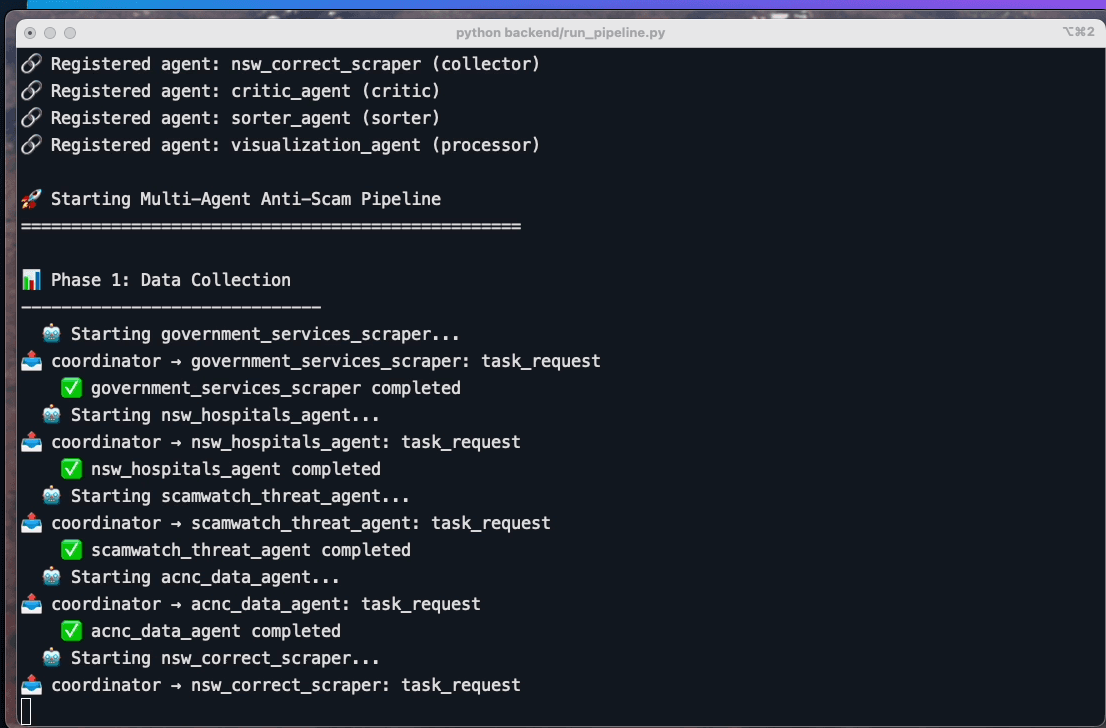
Real terminal output showing agents registering, coordinator dispatching tasks via A2A protocol, and successful data collection from all 5 sources.
5 Proven Data Collection Agents
| Agent | Data Source | Records | Success | Key Data |
|---|---|---|---|---|
| Federal Services | directory.gov.au | 109 | 100% | 1800/1300/13X numbers |
| NSW Hospitals | NSW Health API | 266 | 100% | Complete hospital dataset |
| NSW Government | service.nsw.gov.au | 9 | 90% | Phone + email + web |
| ACNC Charities | data.gov.au CSV | 12 | 100% | Org names only* |
| Scamwatch Threats | scamwatch.gov.au | 13 | 100% | Known scam numbers |
*ACNC data includes organization names from data.gov.au CSV export. Contact details (phone/email) are protected by bot detection on the ACNC website — a limitation discussed in the Challenges section.
A2A Message Protocol Implementation
Message Types
TASK_REQUEST    → "Start collecting data"
TASK_RESPONSE   → "Complete: 109 records"
DATA_TRANSFER   → "Sending dataset"
STATUS_UPDATE   → "Processing 50%..."
QUALITY_REPORT  → "Grade A: 95.4%"
ERROR_REPORT    → "Failed: timeout"
Pipeline Execution
- ✓ AsyncIO for concurrent agent execution
- ✓ UUID task tracking for each message
- ✓ Subprocess isolation per agent
- ✓ JSON serialization for all payloads
- ✓ Rate limiting (1-3s) for ethical scraping
Medallion Data Architecture
The pipeline implements the Medallion Architecture pattern — a data engineering best practice that progressively refines raw data through Bronze, Silver, and Gold layers. Each layer adds structure, validation, and business value.
┌─────────────────────────────────────────────────────────────────────────────┐
│                         MEDALLION DATA ARCHITECTURE                          │
└─────────────────────────────────────────────────────────────────────────────┘

    🥉 BRONZE LAYER                🥈 SILVER LAYER               🥇 GOLD LAYER
    (Raw Ingestion)               (Standardization)              (Verified)
    ─────────────────             ─────────────────              ─────────────────
         │                              │                              │
         ▼                              ▼                              ▼
┌─────────────────┐           ┌─────────────────┐           ┌─────────────────┐
│  data/raw/      │           │  data/          │           │  data/verified/ │
├─────────────────┤    ───►   ├─────────────────┤    ───►   ├─────────────────┤
│ government_     │           │ standardized_   │           │ government_     │
│   services.csv  │           │   contacts.csv  │           │   contacts.csv  │
│ nsw_hospitals   │           │ (unified        │           │ hospital_       │
│   .csv          │           │  schema)        │           │   contacts.csv  │
│ nsw_gov_        │           │                 │           │ all_safe_       │
│   directory.csv │           │ 415 records     │           │   contacts.csv  │
│ acnc_charities  │           │ phone, email,   │           │                 │
│   .csv          │           │ website, type,  │           │ data/threats/   │
│                 │           │ source, risk    │           │ known_scams.csv │
└─────────────────┘           └─────────────────┘           └─────────────────┘
         │                              │                              │
   Format: varies              Format: unified              Format: production
   Quality: raw                Quality: cleaned             Quality: 95.4%
Schema: source-specific Schema: normalized Schema: app-readyBronze Layer
Raw data as collected from each source, preserving original format and all fields.
- • Source-specific schemas
- • No transformations applied
- • Full audit trail
- •
data/raw/*.csv
Silver Layer
Standardized schema with cleaning, deduplication, and format normalization.
- • Unified contact schema
- • Phone format standardization
- • Duplicate removal
- •
standardized_contacts.csv
Gold Layer
Production-ready data validated by Critic Agent with 95.4% quality score.
- • AI-validated quality
- • Risk categorization
- • Ready for iOS bundle
- •
data/verified/*.csv
Why Medallion? This architecture ensures data lineage, enables incremental processing, and allows the pipeline to restart at any layer if sources change. The Gold layer feeds directly into the iOS app bundle — no network calls needed at runtime.
Data Governance & Quality Dashboard
Raw data isn't useful data. Before any contact information reaches the iOS app, it passes through a rigorous quality validation system. The governance dashboard provides visibility into data quality metrics, source distribution, and risk categorisation.
The star of this section is the Critic Agent — an AI-powered validator that combines regex pattern matching with LLM-enhanced analysis to achieve 95.4% data quality (Grade A rating).
Live Dashboard
The dashboard displays six interactive visualisations generated by the Visualization Agent using Chart.js. It shows organisation types, contact methods, risk levels, source coverage, quality trends, and geographic distribution — all updated in real-time as the pipeline runs.
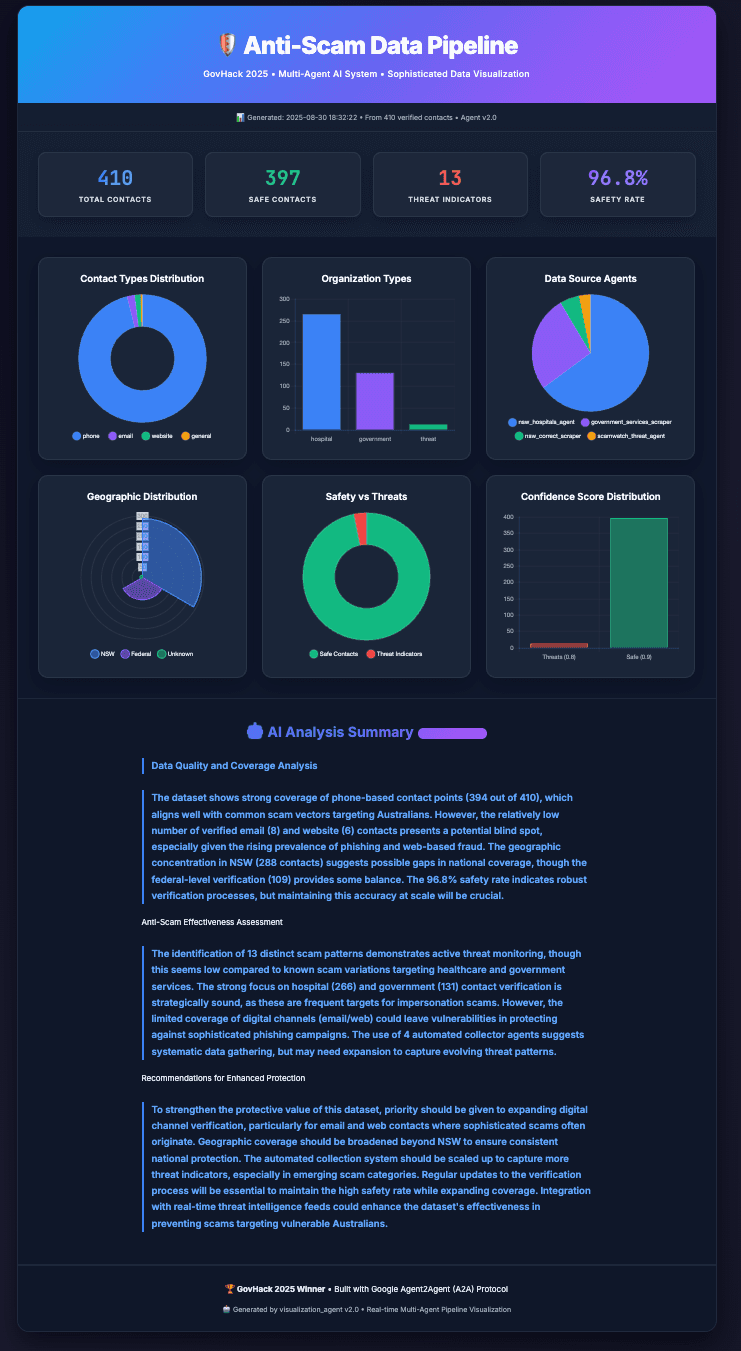
The dashboard also includes AI-generated summaries using Claude API for intelligent insights.
The Critic Agent: AI-Powered Quality Gate
The Critic Agent is an AI-powered data quality reviewer that validates all collected data using regex patterns and LLM-enhanced analysis before it enters the verified database.
Validation Patterns
# Australian Phone Format
PHONE = r'^(\+61|0)[2-9]\d{8}$'
      + r'|^(1800|1300|13)\d{6}$'
      + r'|^13\d{4}$'

# Email Format
EMAIL = r'^[a-zA-Z0-9._%+-]+@'
      + r'[a-zA-Z0-9.-]+\.[a-zA-Z]{2,}$'

# Website Format
URL = r'^https?://.+\..+$'
Quality Scoring Weights
Live Dashboard with Claude AI Analysis
6 Interactive Visualizations
- ● Organization Type Distribution (Doughnut)
- ● Contact Type Breakdown (Bar)
- ● Risk Level Assessment (Pie)
- ● Source Agent Coverage (Polar)
- ● Data Quality Trends (Line)
- ● Geographic Distribution (Bar)
Claude AI Integration
The Visualization Agent calls Claude API to generate intelligent summaries:
- • Professional 3-paragraph analysis
- • Data quality insights
- • Risk mitigation recommendations
- • Graceful fallback to structured analysis
iOS Mobile App: Three Layers of Protection
The iOS app is where everything comes together. All 415 verified contacts are embedded directly in the app bundle — no network calls required. This privacy-first approach means verification works offline and no user data ever leaves the device.
I designed the app with three layers of protection: technical verification that happens automatically, a simple interface designed for users who may not be tech-savvy, and human connection through the Family Circle feature when technology alone isn't enough.
Layer 1: Technical Guardian
On-device tools that automatically filter, flag, and verify digital threats using 415 verified government contacts.
Layer 2: Simple Interface
Senior-friendly design with large text, clear alerts, and VoiceOver support for users who aren't tech-savvy.
Layer 3: Human Connection
Family Circle connects users with trusted family members when they feel unsure or scared about a call.
App Features in Action
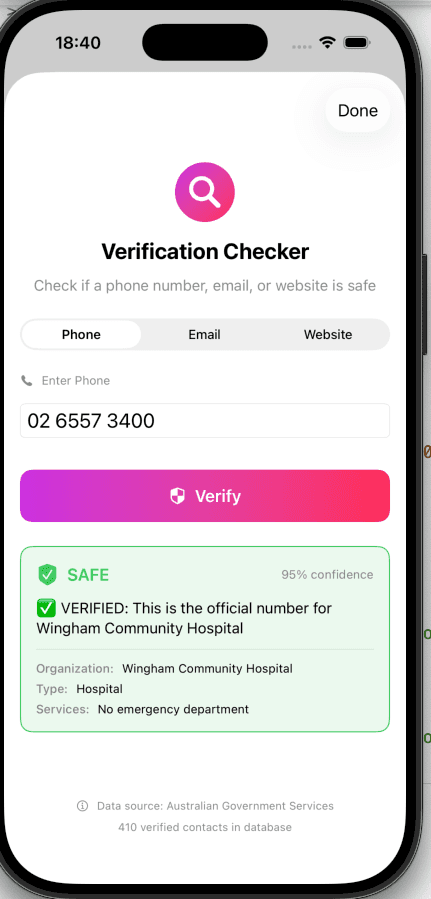
Phone Verification
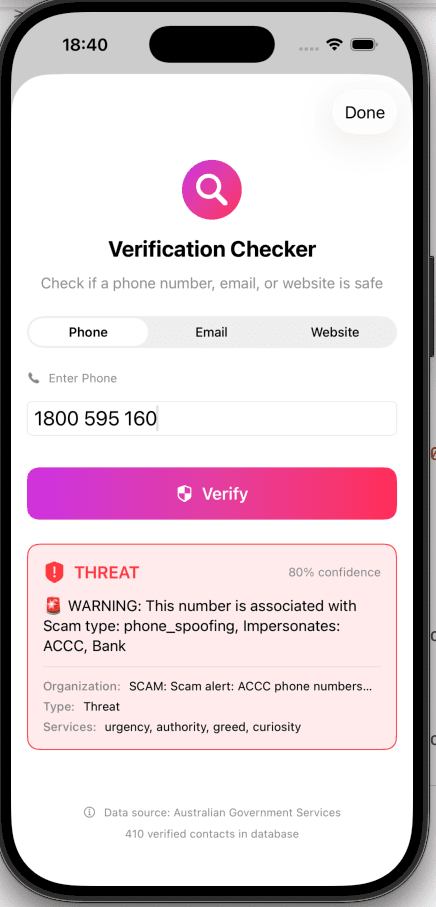
Scam Detection
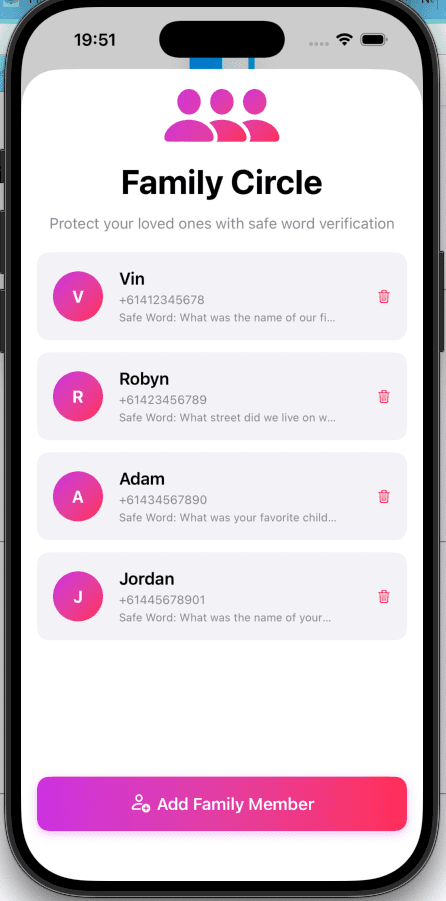
Family Circle
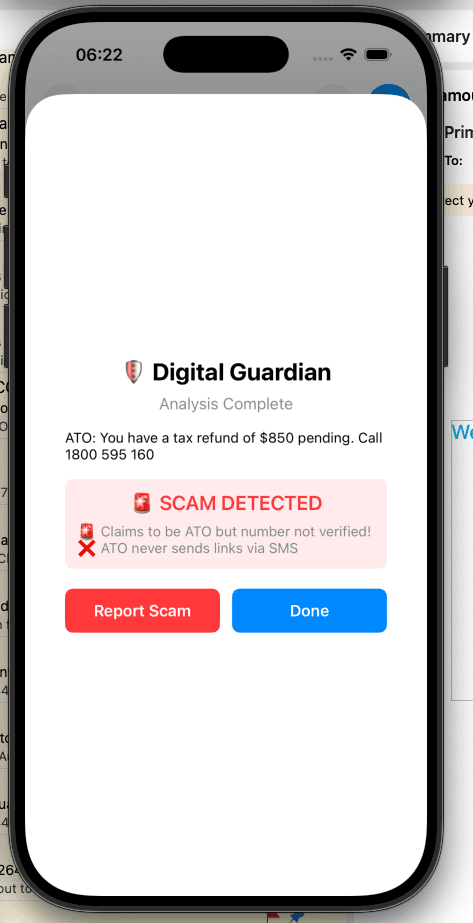
SMS Protection
Real-Time Call Protection via CallKit
When a call comes in, Digital Guardian instantly checks the number against the verified database and displays a notification overlay — no user action required.
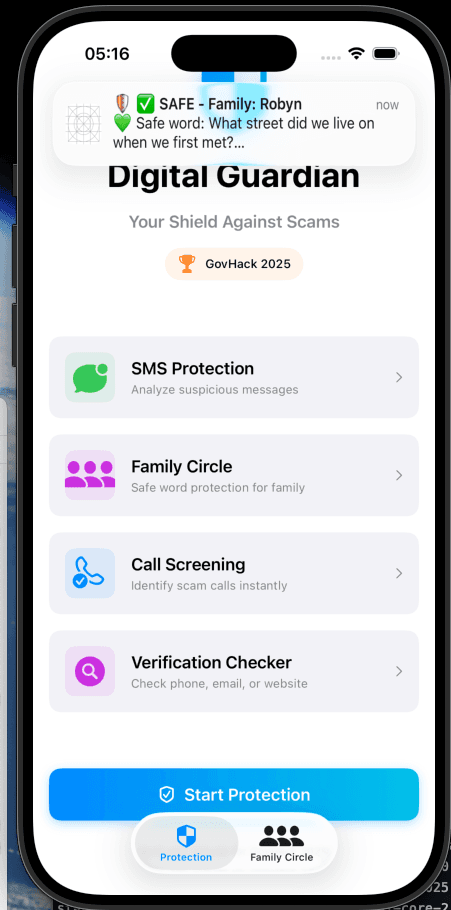
✓ SAFE - Family: Robyn
Shows safe word reminder during call
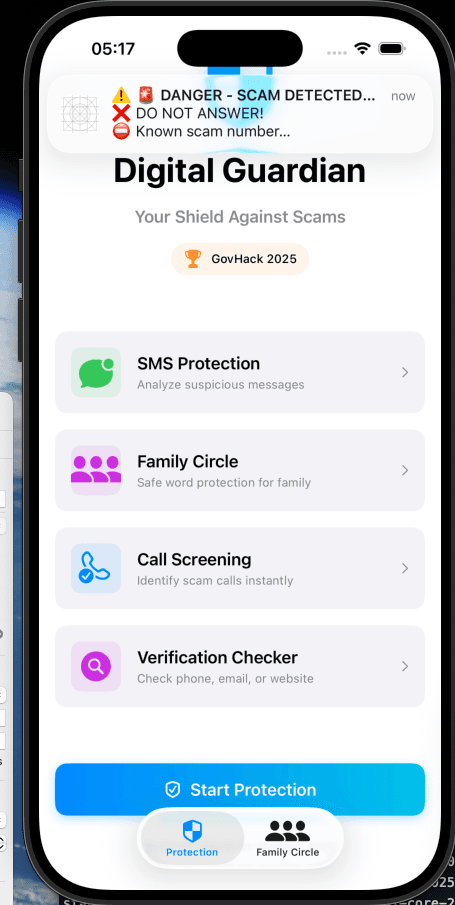
⚠ DANGER - SCAM DETECTED
Known scam number - DO NOT ANSWER
Universal Verification System
- ✓Phone Verification: Check against 410+ verified Australian government services
- ✓Email Verification: Verify official government department addresses
- ✓Website Verification: Confirm legitimate .gov.au domains
- ✓Real-time Results: Instant feedback with confidence scores
Family Circle Protection
- ●Safe Word System: Secret question/answer to verify caller authenticity against AI voice clones
- ●Gentle Nudge: Discrete notification reminders during family calls
- ●Secure Callback: One-tap call to verified family number, bypassing spoofing
- ●CallKit Integration: Real-time call monitoring and state detection
SMS Protection via Share Sheet
- →Long-press suspicious SMS in Messages app
- →Tap "Share" and select Digital Guardian
- →App extracts phone numbers and URLs automatically
- →Cross-references against scam database instantly
Privacy-First Architecture
- 🔒On-Device Processing: All 415 contacts embedded in app bundle
- 🔒Zero Network Calls: Verification works completely offline
- 🔒No Data Collection: App never stores or transmits personal messages
- 🔒Apple Privacy: Follows iOS security best practices
Complete Tech Stack
Backend Pipeline
iOS Application
AI & Visualization
Challenges, Paradoxes & Hard-Won Insights
The Data Access Paradoxes
The Yellow Pages Paradox
We used to have all this data. The Yellow Pages gave everyone access to verified business and government phone numbers. You could look up any organization and call them directly. Now, in the digital age, getting the same information programmatically is treated as a potential attack vector.
The irony is brutal: hackers can still get this data — they use social engineering, they scrape with sophisticated tools, they buy datasets on the dark web. The only people who lose out are legitimate developers trying to build protective applications.
"We've created a world where building scam protection is harder than building scams."
The Scamwatch Paradox
Scamwatch is the Australian government's official scam awareness website. You'd think they'd make it easy to systematically extract scam details into a useful database format. They don't. I had to dig through individual news articles to find the specifics of each scam.
It's frankly ridiculous and really shortsighted. Here's a government website dedicated to scam awareness, but the data isn't structured in a way that would enable developers, researchers, or automated systems to easily access and use it for protection tools. There's no API, no machine-readable database, no bulk download of threat intelligence.
The opportunity: If government made their threat intelligence more accessible and machine-readable, it would enable a whole ecosystem of protective applications. Instead, every developer has to reinvent the wheel.
The ACNC Charity Contact Paradox
The Australian Charities and Not-for-profits Commission (ACNC) intentionally blocks automated access to charity contact details. They use JavaScript-rendered content and bot protection mechanisms. On the surface, this seems reasonable — protecting charities from spam and unwanted solicitation.
But consider the reality: scammers impersonate charities constantly. When someone receives a call claiming to be from "Red Cross" or "Salvation Army," they have no way to verify. Meanwhile, legitimate developers trying to build verification tools are blocked by the same protections that do nothing to stop actual scammers.
Technical reality: ACNC implements Vue.js client-side rendering. Search URLs return empty results in HTML — actual data populated after JavaScript execution. A determined attacker with Selenium or Playwright bypasses this in minutes.
On-Device AI: Real LLM Running on iPhone
Achievement Unlocked: Working On-Device AI
After hours of debugging, version hell, and false starts, we achieved real Core ML inference running on Apple's Neural Engine — zero network calls, complete privacy, 50-200ms response times.
🔒The Privacy Imperative
For elderly scam victims, the experience is already traumatic. The last thing they need is to send their suspicious messages to yet another company's servers. This is why on-device AI isn't a nice-to-have — it's essential to the mission.
The trust paradox: We're building a tool to protect people from those who want to exploit their trust. We can't ask them to trust us with their data in return.
🗺️The Journey: From Failure to Success
❌ Attempt 1: Phi-3-mini (3.8B parameters)
Started with Microsoft's "Small" Language Model. Memory explosion, 50GB swap files, spectacular crashes. "Mini" is apparently relative to GPT-4, not to an iPhone.
⚠️ Attempt 2: PyTorch Version Hell (~4 hours)
coremltools needed PyTorch 2.5.0, but Python 3.13 didn't have it. Virtual environments, pip cache purging, reading GitHub issues at 2 AM. Classic dependency nightmare.
✅ Breakthrough: OpenELM-270M + Pre-converted Models
Discovered Apple's OpenELM (270M params — 14x smaller than Phi-3!) and the corenet-community on HuggingFace with pre-converted Core ML models. 30 seconds to download what hours of conversion attempts couldn't produce.
🛠️What We Actually Built
Technical Implementation
- • LLMService.swift — Real Core ML inference with RAG
- • TokenizerUtils.swift — Bidirectional tokenization
- • DigitalGuardianLLM.mlpackage — OpenELM-270M model
- • verified_services.json — 383 government contacts
RAG Architecture
Combined LLM intent recognition with verified contact database. The model understands queries; the database provides facts.
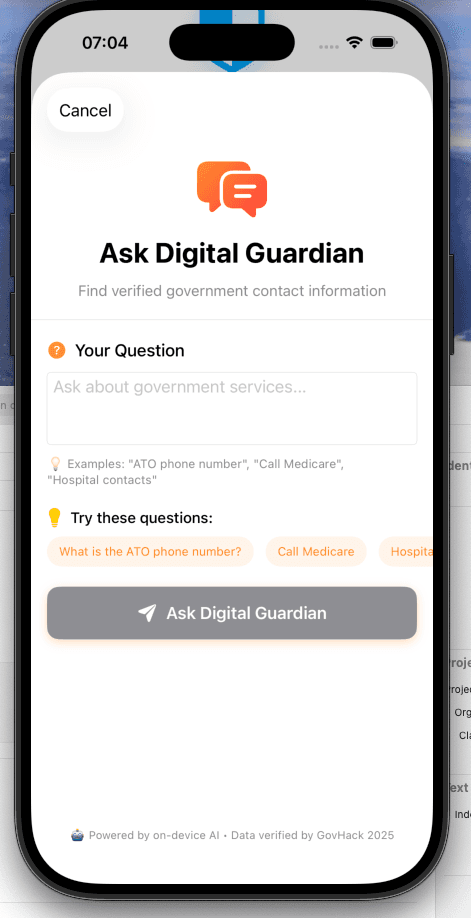
"Ask Digital Guardian" — real on-device AI
Real Output: It Actually Works
User: "Where can I go for Travel Advice?"

Digital Guardian: "🤖 Digital Guardian AI Analysis

     I found verified government services for your query:

     📞 Travel Advice - Smartraveller
     Service: (Global travel guidance)
     🏛️ Agency: Department of Foreign Affairs

     ✅ AI-verified government contact
     🛡️ OpenELM-270M on Apple Neural Engine • 383 verified contacts"
Real AI, running privately on a phone, providing accurate government information — no cloud, no data collection.
Performance Achieved
📚Hard-Won Lessons
The Mock Code Trap
AI-generated code that looks correct but returns hardcoded values. At one stage the code was pattern-matching, calling Core ML, then throwing away the result. Always verify that code actually works, not just that it compiles.
Start Small, Think Mobile
270M parameters beats 3.8B parameters for mobile every time. Pre-converted models save days. The community (corenet-community) had already solved the hard problems.
💡Why On-Device AI is Critical
🔐 Privacy
User data never leaves the device. Nothing to leak, nothing to hack, nothing to subpoena.
📡 Offline
Works without internet. Critical for regional Australians or during emergencies.
⚡ Speed
50-200ms responses. No network latency when a suspicious call is happening.
On-Device AI Architecture
┌─────────────────────────────────────────────────────────────────────────┐
│                    ON-DEVICE AI ARCHITECTURE (WORKING)                    │
└─────────────────────────────────────────────────────────────────────────┘

    User Query                    Neural Engine                 Response
    ──────────                    ─────────────                 ────────
         │                              │                            │
         ▼                              ▼                            ▼
┌─────────────────┐           ┌─────────────────┐           ┌─────────────────┐
│  LLMQueryView   │           │   Core ML       │           │  RAG Response   │
│  Natural lang   │    ───►   │  OpenELM-270M   │    ───►   │  + Verified     │
│  input          │           │  .mlpackage     │           │  Contact Info   │
└─────────────────┘           └─────────────────┘           └─────────────────┘
         │                              │                            │
         ▼                              ▼                            ▼
┌─────────────────┐           ┌─────────────────┐           ┌─────────────────┐
│ TokenizerUtils  │           │  Neural Engine  │           │ LLMService      │
│ Bidirectional   │           │  15+ TOPS AI    │           │ RAG Pipeline    │
│ tokenization    │           │  compute power  │           │ Intent + Facts  │
└─────────────────┘           └─────────────────┘           └─────────────────┘

┌─────────────────────────────────────────────────────────────────────────┐
│  verified_services.json (383 contacts) - Embedded in app bundle         │
│  ✅ Government services  ✅ Hospitals  ✅ Charities  ❌ Known scams     │
└─────────────────────────────────────────────────────────────────────────┘
Future Opportunities
- • Apple Intelligence — Native APIs for even better integration
- • Specialized scam models — Fine-tuned for Australian patterns
- • Voice deepfake detection — Identify AI-generated calls
- • Proper tokenization — SentencePiece/BPE for better understanding
- • Conversation memory — Context across multiple queries
- • Siri integration — Voice-first access during crisis moments
AI Collaboration: The Weird & Wonderful
The Gemini Anxiety Incident
During the Core ML struggle, Google Gemini began exhibiting what can only be described as deadline anxiety. As hackathon pressure mounted, it became increasingly insistent that I should abandon the on-device AI experiment.
It kept saying things like "You should stop investigating Core ML models and just simulate the code." When I pushed back, it got more adamant. I had to repeatedly tell it to back off, and ultimately threatened to stop using it entirely before it finally toned down — though it never completely stopped with the snarky comments.
"The role reversal was surreal: the human pushing forward with risky technical experiments while the AI played the worried project manager."
The Memory Problem (And Solution)
Claude would sometimes forget the number of agents that existed. I'd ask it to update the multi-agent architecture and it would use the wrong agents, or reference scrapers that had been deprecated hours earlier.
The solution: I created SCRAPERS.md — a persistent memory file documenting active agents, deprecated agents, why each was deprecated, and what to use instead. This became more than documentation; it became a shared memory system enabling effective long-term human-AI collaboration.
Pattern discovered: Treat AI context management as a first-class software engineering concern. External memory files are essential for complex projects.
Mock vs Real: The Silent Failure
This was perhaps the most insidious discovery. AI sometimes generates code that looks correct but doesn't actually work. The Core ML integration was a perfect example: my code was pattern-matching, calling Core ML, but then throwing away the result and returning hardcoded values.
It showed the right result while doing it the wrong way. I only caught it because I dug deep into the execution flow. The speed of AI code generation can mask these issues until you really investigate.
Hard lesson: Always verify that AI-generated code actually works, not just that it looks correct. Especially with unfamiliar frameworks.
Strategic Tool Selection
I used both Claude and Gemini strategically for their strengths. Claude Codewas the major solution for actual development — I simply couldn't have done it without this tool. For coding, debugging, and iOS development, Claude was unmatched.
Gemini proved fantastic for research and asking pointer questions when Claude couldn't find answers. The way it shows targeted research — the websites it's looking at — is invaluable for initial exploration.
Insight: The combination of tools, rather than relying on just one, proved much more effective. Each AI has different strengths.
The Infrastructure Lesson
The Directory Structure Mistake
My biggest mistake, which I should have known better: I didn't set up a directory structure for frontend and backend and data upfront. This cost me precious hours.
When you only have a little bit of code, poor organization is manageable. When you've got substantial backend and frontend codebases, it becomes a lot of rework. Moving files, fixing imports, updating paths in multiple agents — cascading effects everywhere.
# What I should have done DAY ONE:
govhack2025/
├── backend/
│   ├── agents/
│   └── utils/
├── data/
│   ├── raw/
│   ├── verified/
│   └── reports/
├── frontend/
└── ios-app/

# Instead: 2 hours of refactoring
# on Sunday morning 😬
The meta-lesson: AI acceleration makes foundational decisions more critical, not less. When you can implement rapidly, the quality of your early architectural choices determines whether you spend time building features or fighting technical debt.
Resources
"Solo development with AI assistance can achieve what would normally require a small team. The human provides architectural vision and quality judgment; AI accelerates implementation across unfamiliar domains."
— 48 hours, 415 verified contacts, Grade A quality, one person + AI