Dare to Shift Left on Architecture Governance?
Does your architecture governance take longer than the decisions it's meant to guide? What happens when you replace the review board with shift-left, early-stage advisory - and is your organisation ready for what that actually demands?
The question isn't whether your governance model needs to evolve. It's whether you're willing to lead that evolution - and to be honest about the trade-offs involved.
Architecture governance has a reputation problem. Say the words "Architecture Review Board" in most organisations and watch the room deflate. Eyes glaze. Shoulders tighten. Project managers start calculating how many weeks this will add to their timeline.
And honestly? They're not wrong to be wary.
Here's the thing. The traditional model - present your solution to a panel of architects or technology leaders who've had fifteen minutes to skim your document, field a volley of questions that may or may not be relevant, receive a verdict - is what amounts to governance theatre. It creates the appearance of oversight without reliably producing better outcomes. Even worse, it arrives too late. By the time a solution reaches a formal review board, the team has already committed to an approach. Telling them to rethink it at that point isn't governance. It's an impossibility. It's disruption.
I've sat on both sides of that table many times. I've established and run architecture review boards. I've been the architect asking probing questions about decisions that were made months ago. And I've been the one presenting a solution to a board that hadn't been involved in any of the thinking that led to it.
There's a better way. And it requires something most governance frameworks don't ask of you: the courage to be lightweight.
But I want to be upfront about something from the start. I've implemented this approach. It works - and it also costs more than the literature suggests, in ways I didn't anticipate. This article covers both sides: the model and what it actually demands of you. Because I don't think you can honestly talk about one without the other.
What Shift-Left Actually Means
The term "shift left" comes from DevOps - the idea that testing, security, and quality checks should move earlier in the pipeline rather than sitting as gates at the end. Applied to architecture governance, the principle is the same: embed architectural thinking at the beginning of an initiative - not when it's already a formal project, not as a checkpoint before deployment.
In practice, this means architects are involved from discovery. They're in the room when the problem is being framed, not summoned when the solution is already built. They're nudging and shaping direction through conversation, not enforcing compliance through documentation. The artefacts still matter - architecture decision records, risk registers, integration patterns - but they emerge from collaboration, not from a review board's interrogation.
The shift isn't about removing governance. It's about moving it to where it actually influences outcomes - early enough to shape decisions, rather than late enough to only rubber-stamp or reject them.
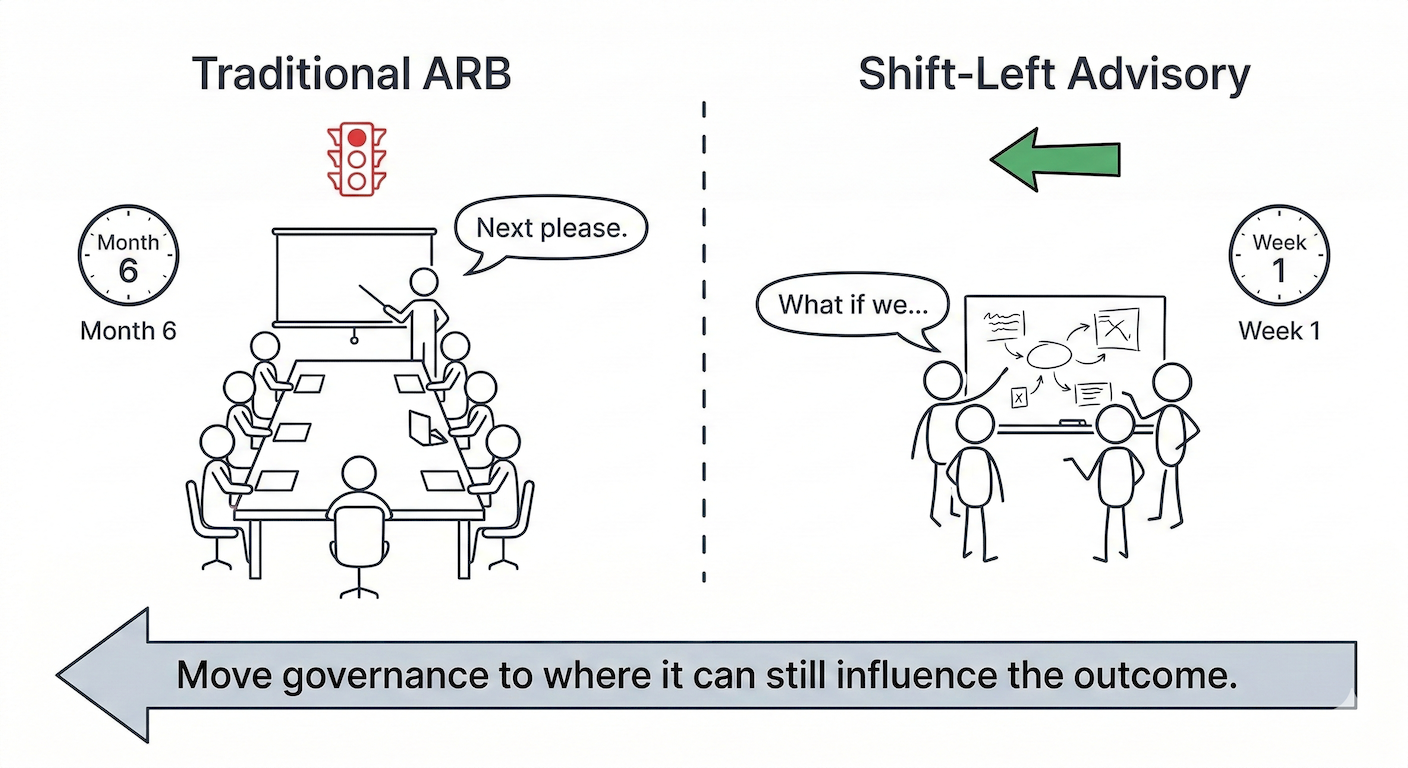
But shifting left also means changing how governance feels. Traditional governance is presentational: teams prepare a deck, board members sit in judgement, there's formal Q&A within an allotted timeframe, and the outcome is approve/reject/defer. To be fair, good ARBs often include a socialisation process - pre-reads, corridor conversations, one-on-ones with key stakeholders before the formal session - to give people additional time to absorb and challenge. But that socialisation is often informal and inconsistent, and the formal meeting remains the point at which governance is seen to happen. Shift-left governance is conversational: a one-page context setter - a single overview slide at most - followed by a working discussion between the people who actually need to be in the room. One of the practical shifts this requires is moving away from the traditional model of convening a single board meeting that covers multiple topics - where each initiative gets its allotted twenty minutes - to smaller, focused sessions on one topic at a time, with the right people for that specific discussion.
That changes the power dynamic fundamentally. The architect facilitating the session isn't chairing a tribunal - they're running a collaborative problem-solving conversation. Knowing when to let a discussion run because it's generating genuine insight, when to park something because it's going in circles, and when to pull in a specialist because the conversation has hit a domain boundary. This is harder than chairing a formal review, not easier. Strong facilitation is a core skill in this model - and it's one that many architects haven't had to develop.
There's a cultural dimension here that's easy to overlook. Architects have traditionally been expected to operate independently - work through problems on their own, arrive at a position, and present it with authority. That's what the profession has rewarded. Their ways of working don't naturally elicit peer discussion early in the process. Shift-left governance asks them to do the opposite: to bring half-formed thinking into a room, to shape solutions collaboratively rather than unveiling them, and to treat architecture as collective wisdom rather than an individual craft. For some architects, that's a bigger shift than any process change.
The Governance Theatre Problem
I want to be direct about this. A significant amount of what passes for architecture governance in large organisations is performance. A ritual. Teams prepare documents to satisfy a process, boards review them to discharge a responsibility, and the actual architecture decisions - the ones that shape whether a system will scale, integrate cleanly, or create technical debt for the next five years - those decisions were already made in a sprint planning session three months earlier.
The review board doesn't know this. Or worse, it does know - and processes the submission anyway, because that's what the framework says to do.
If governance is happening after the real decisions are made, it's not governance. It's documentation.
TOGAF itself acknowledges the problem with architecture principles, noting that a common reaction is "this is motherhood" - the principles are so abstract and self-evident that they provide no practical guidance. What does "prefer loose coupling" actually mean when you're choosing between a synchronous API call and an event-driven pattern for a specific integration? The principle offers little practical help.
Gerben Wierda put into words what I'd been uncomfortable with for a while in his critique "Architecture Principles Considered Harmful". His argument is straightforward: "comply or explain" sounds reasonable, but it creates a bias towards dogmatic adherence over thoughtful application. Following a principle requires no justification. Deviating requires approval. So under delivery pressure, teams default to compliance even when an exception would produce a better outcome, because being thoughtful about it takes effort and time that projects can't spare.
I like Thoughtworks' framing of this problem. They've deliberately replaced the language of "best practices" with "sensible defaults" - the idea being that a best practice implies something you should always follow without thinking, whereas a sensible default is a starting point you use in the absence of a better option, with the explicit expectation that you'll think about whether it applies to your context.
Architecture governance would benefit from exactly the same reframe. Principles should not be rules that teams comply with mindlessly. They should be sensible defaults - well-grounded starting positions that teams adapt based on the specifics of the problem in front of them. The governance process should support that adaptation, not penalise it.
There's a further step that's worth considering. In modern platform-centric landscapes, the most effective principles aren't documents at all - they're codified in the platforms themselves. If your integration middleware enforces API standards, if your cloud landing zone encodes security and networking policies, if your data platform has quality and classification rules built in, then governance is happening through engineering rather than through process. The platform is the principle. That's a more honest and durable form of governance than asking teams to read a standards document and comply - because the guardrails are embedded in the thing they're building on, not in a PDF they'll never open.
Risk-Based, Not One-Size-Fits-All
One of the most common mistakes in architecture governance is treating every initiative the same way. Building a solution on existing platforms that operational teams already know and support is a fundamentally different proposition from introducing a new product that will require new skills, new resources, and ongoing commitment for years to come. Yet both often go through the same governance process.
A risk-based model changes this. Assess each initiative for architectural risk - integration complexity, data sensitivity, vendor dependency, scale of change - and calibrate the governance response accordingly.
Architecture risk in this context isn't project risk or delivery risk. It's the risk that a technology decision will be difficult or expensive to reverse, will create dependencies or constraints that affect other parts of the landscape, will introduce technical debt that compounds over time, or will add complexity to the enterprise rather than reducing it. A poorly chosen integration pattern might work fine for the project that implements it but create a maintenance burden across every system that touches it for years. That's the kind of risk governance should be calibrated to catch - not whether a project will deliver on time.
It's worth being honest: the initial assessment of architecture risk is more artform than science. An experienced architect looks at an initiative and makes a judgement call based on pattern recognition, knowledge of the landscape, and instinct. That's fine. The purpose of triage isn't to produce a definitive risk score - it's to set the initial level of effort and priority. The assessment gets validated as the engagement progresses, and if the risk turns out to be higher or lower than first thought, you adjust. The streaming model is a starting position, not a sentence.
Light Governance
Low-risk, well-understood changes. A brief architecture review - often asynchronous - with documented decisions. The architect is a sounding board, not a gatekeeper. If a team is extending an integration using a pattern that's been successfully used a dozen times before, governance should be near-invisible.
Medium Governance
Moderate complexity or cross-domain impact. One or two focused clinics with the right subject matter experts, documented decision records, and periodic check-ins as the solution evolves. Small group, right people, time-boxed.
Heavy Governance
High-risk transformations - new platforms, major integrations, significant data migration, or cybersecurity programmes. This is where a two-tier model works best. First, a design advisory session - a curated group of architecture, business domain, and management stakeholders selected because they have something to contribute to this specific problem, not a standing committee with fixed membership. A single overview slide for context, then a working conversation about risk, direction, and options. Second, where the advisory session surfaces technical complexity that can't be resolved in that forum, it delegates to a working group - a smaller, purely technical group of specialists who work through the detail informally, time-boxed, and report findings back for a decision. That two-tier pattern keeps the right people in the right conversations.
The key insight: most initiatives don't need heavy governance. When you reserve formal rigour for the work that truly demands it, the heavy process gains credibility because it's no longer seen as bureaucratic overhead. And the lighter processes gain adoption because teams experience governance as proportionate rather than punitive. It works in the other direction too - when a project that started as high-risk has been steered in the right direction and the architecture risk has reduced, the governance scrutiny should drop to medium or light. Governance intensity should track the actual risk, not stay locked to the initial assessment.
Ideally, work should be triaged into streams quickly - within three business days - and the first clinic for medium or heavy governance scheduled within five. Those SLAs matter. They demonstrate that governance is responsive and doesn't create unnecessary wait states.
But the reality in an overworked organisation is that many things compete for your time. Architecture teams are typically understaffed relative to the transformation agenda they're expected to cover. You must prioritise where possible, but accept the reality that you or other reviewers are simply too busy to meet those targets every time. The SLAs are aspirational benchmarks, not a stick to beat yourself with. What matters is that teams see responsiveness as the intent - and that when triage is delayed, it's because of genuine capacity constraints, not because governance doesn't care.
The Tooling Matters More Than You Think
Traditional governance tooling tends to prioritise form over function. SharePoint document libraries, PowerPoint-heavy review processes, formal templates where layout matters more than content, approval workflows that add weeks without adding insight. A significant amount of governance effort goes into maintaining these bureaucratic artefacts rather than doing actual governance work.
The opportunity isn't to abandon tooling - it's to use it differently. Tools like Jira and Confluence can drive the governance process rather than just document it. Architecture Decision Records - lightweight documents that capture a specific decision, the alternatives considered, the trade-offs weighed, and the rationale for the path chosen - live in a wiki where they're searchable, linkable, and visible. Over time, your ADR registry becomes a living body of institutional knowledge. Pair that with a centralised risk registry and governance workflows tracked on a board the whole team can see, and you have a system built on actual decisions and real risks rather than aspirational principles.
If it takes longer to navigate the governance process than it does to make the architecture decision, your process is the problem - not the teams avoiding it.
These tools aren't perfect, and not all the problems go away. You still need to think about what constitutes the document of truth - a wiki page is editable by anyone, which is great for collaboration but raises questions about version control and sign-off. You may still need to create PDF snapshots as formal records at key decision points. Dashboards in Jira give you operational visibility but limited strategic insight. You'll likely need to supplement with something like Power BI dashboards that can aggregate and visualise governance data for a leadership audience.
But open-by-default tooling creates practical challenges. When the governance register is visible to the entire organisation, how do you handle items that are commercially sensitive or touch on matters leadership hasn't communicated yet? Wiki pages and Jira dashboards work well for operational governance, but they're inadequate for strategic reporting to executives who expect curated, contextualised insight - "here are the three most significant architectural risks this month, here's what we're doing about them, here's what we need from you."
The practical implication: plan for multiple audiences from the outset. Self-serve transparency for delivery teams, operational dashboards for the governance function, and curated strategic reporting for oversight. Tools like Jira and Confluence will get you 80% of the way there. The remaining 20% - strategic reporting, sensitive items, formal records - will need different formats for different audiences.
What It Actually Takes - And What Nobody Warns You About
Here's where the "dare" comes in. Everything I've described above is the model. It's the easy part. The hard part is getting an organisation to adopt it - and sustain it - because shift-left governance demands things that the frameworks and blog posts don't prepare you for.
You Have to Let Go of the Gate
The traditional review board gives architects positional authority. You control the gate, therefore you matter. Shift-left governance replaces that with influence - you matter because teams want you in the room, not because they have to get past you. That's a harder kind of authority to earn. And a more durable one - if you can build it.
But it's not just architects who need to let go. Other parts of the organisation expect the ceremony too. Executives associate governance with the gravitas of a formal board. Process champions want a clear, structured waterfall - intake, review, approve, close. Programme managers feel reassured by the ritual. Replacing that with an informal advisory conversation and a Confluence note can feel like a downgrade to people who equate rigour with formality.
What you're really doing is shifting from a ceremonial model to a delivery-first mindset - one that gets things done faster, earlier, and cheaper. But you need to bring the organisation along with that shift, not just the architecture team.
The Exposure Problem Nobody Talks About
This may be the most significant unintended consequence of shift-left governance, and it's almost entirely absent from the published guidance. The shift-left literature overwhelmingly focuses on the benefits - earlier engagement, lower cost of change - and the adoption challenges like cultural resistance and tooling. Very little is written about what it costs the architect personally when the gate disappears.
In a traditional ARB model, when something goes wrong, ten people were in the room when the decision was reviewed. There's collective accountability - or at least collective witness. The architecture function is protected by the ceremony it facilitated.
In a shift-left model, governance often happens in a quick conversation between an architect and a delivery lead at the ideation stage. That's where the value is - catching risks early, shaping decisions before they calcify. But it also means the architect is frequently the only person who saw the risk. If that advice is ignored or misunderstood, there's no collective witness.
In my experience, when architects start showing up during discovery instead of waiting at the review gate, teams don't always welcome it. Project managers can find it frustrating to have architectural questions raised before they've finished scoping. Senior stakeholders ask - not unreasonably - why architecture is looking at something that hasn't been formally referred yet. People don't recognise what's happening as governance at all, because it doesn't look like a board meeting with a slide deck and an approval stamp.
The advisory positioning compounds this. When you position yourself as an advisor rather than a gatekeeper, people hear "optional." Teams take the guidance when it's convenient and ignore it when it isn't. And when things go wrong - when the integration pattern you flagged early turns out to be exactly the issue six months later - nobody remembers the early conversation.
The discipline required is to log every one of these conversations - advisory notes in Jira, comments on governance tickets, a running history of what was discussed, what was recommended, and what the team decided to do. If you do this consistently, you accumulate a record that protects you and the organisation. But the reality is that early-stage conversations are fast, informal, and often happen in corridors or on calls where documentation feels like overhead. The moment you let a few slip through undocumented, you've traded the protection of the gate for the influence of the room - and discovered that influence without a paper trail leaves you exposed.
This isn't a theoretical risk, and I'll be honest - I didn't fully recognise the vulnerability until it was too late to fix it. Practical mitigations: always document advisory notes and link them to governance tickets - never verbal-only. Make it explicit when advice isn't followed, with the rationale recorded. Ensure oversight has visibility of cases where advisory input was overridden.
One thing that's changing here is AI tooling. The ability to generate meeting summaries, extract decisions from unstructured conversations, and draft advisory notes from call transcripts means we can increase the formalisation of what's captured without increasing the effort. That doesn't solve the exposure problem entirely, but it significantly lowers the barrier to maintaining the documentation discipline that shift-left governance demands.
Even so, this tension isn't fully resolved. It may be inherent to the model.
Adoption Is Not a Phase - It's a Permanent Cost
A traditional ARB, for all its flaws, is a pattern that most people in enterprise IT recognise. They know what a board meeting looks like, how to prepare a deck for review, and what approve/reject/defer means. When you replace that with something novel - design advisory sessions, working groups, risk-based streaming, advisory notes instead of approvals - you're asking people to learn a new way of working.
And unless you keep reinforcing it, they revert. New people join and have never heard of the model. Existing people forget the detail and fall back on prior assumptions. Every time someone has a frustrating experience with the process, they question whether it works at all. The governance function must be prepared to explain the model - clearly, patiently, repeatedly - for as long as it exists. That's not a failure of communication. It's the nature of change in complex organisations.
A key takeaway: this is exactly the kind of challenge that benefits from working with your organisation's change management team - if you have one.
Executive Oversight Must Be Earned and Defended
A lightweight governance process does not mean lightweight accountability. This distinction is easy to state and difficult to maintain.
Shift-left governance only works if everyone involved understands what they're signing up for. A RACI on paper is just a diagram. Making it come to life means that every person in a responsible, accountable, consulted, or informed role recognises the time commitment and prioritisation that governance demands of them - not just the architecture team, but delivery leads, programme managers, and executives too.
Here's the practical problem. In a shift-left model, the architecture function is triaging initiatives, running advisory sessions, flagging risks, and documenting decisions. Inevitably, some of those risks can't be resolved at the advisory level - they need executive input and support. A vendor decision with significant lock-in implications. A programme that's accumulating technical debt faster than it can be paid down. An integration approach that creates dependencies across multiple business units. These are the items that get escalated to oversight.
If the oversight meetings where those escalations are heard don't happen - because they get delayed, deprioritised, or squeezed out by operational pressures - those risks sit in a gap. The architecture function has flagged them, but nobody with authority has heard them. And when something goes wrong downstream, leadership can't have your back on a decision they were never briefed on.
This isn't about executives being negligent. It's about the gravitational pull of operational priorities in any busy organisation. Oversight cadence erodes gradually, not through any deliberate decision. But the consequence is real: the architecture function is doing the work but the organisational authority that gives governance teeth is absent. Material risks have nowhere to go.
The lesson is blunt: shift-left governance requires more discipline at every level, not less. The lightweight process is lightweight in format - it should not be lightweight in commitment.
Executives need to show up for oversight. Delivery leads need to engage with advisory sessions rather than treating them as optional. Programme managers need to build governance touchpoints into their plans rather than working around them. And the architecture function has a role to play too - if oversight meetings become routine status updates, executives will rightly deprioritise them. If they consistently surface decisions that require executive input and support, they earn their place in the calendar.
The Political Reality
Establishing governance in an organisation that has never had it - or that has had only nominal governance - is fundamentally a change management challenge. The process design is only the beginning of the journey. The human and political dimensions are where it succeeds or fails.
Delivery teams resist being called out. People who have operated without architectural oversight experience governance as interference rather than support. Being asked to justify a technology choice feels like criticism of their competence, not a collaborative improvement. There's also a fundamental tension in perspective: project teams are focused on horizon one - delivering the current initiative on time and on budget. Architecture governance is also looking at horizons two and three - how this decision affects the landscape in two years, what it means for the next team that has to integrate with it. Those perspectives will naturally conflict, and that conflict is healthy, but it doesn't always feel that way in the moment.
Organisational maturity determines reception. In mature organisations, governance is understood as a normal part of how decisions are made. In less mature organisations, it's perceived as an unwelcome layer of bureaucracy imposed by people who don't understand delivery reality.
The governance function must pick its battles. Not every hill is worth dying on. Success begets success. Credibility is built through a track record of useful, timely advice - not by fighting every decision. You need to be politically astute about when to push hard - material risk, significant lock-in, decisions that will be expensive to reverse - and when to document concerns and let things proceed. Getting this balance wrong in either direction undermines your standing.
What Happens When Governance Is Bypassed
It will happen. A business unit procures a SaaS tool directly. A delivery team makes a significant integration decision without involving the advisory function. A vendor is selected during procurement without architecture input.
How you handle it says everything about the model's maturity.
Punishing the bypass reinforces the policing perception you're trying to escape. But ignoring it undermines the model entirely - if there are no consequences for circumventing governance, rational actors will circumvent it whenever it's inconvenient.
The middle ground is retrospective advisory review: acknowledge the decision has been made, document what was decided and why, flag any risks or technical debt that resulted, and ensure the learning feeds back into the process. Was the bypass because the team didn't know about governance? Because the process was too slow? Because they knew governance would flag a problem they didn't want surfaced? The response to the bypass is often more revealing than the bypass itself. It's an opportunity to improve the model, not just to enforce it.
How Do You Know It's Working?
Traditional governance measures itself by compliance - how many reviews were conducted, how many exceptions were raised, how many documents were signed off. These are activity metrics, not outcome metrics. They tell you the machine is running but not whether it's producing anything useful.
Better measures:
- →Time to engagement - how early does an architect get involved?
- →Decision velocity - how quickly are architecture decisions being made and documented?
- →Voluntary engagement - are teams seeking out architects, or only engaging when forced?
- →Rework rate - are integration issues and scalability problems being caught early or discovered in production?
- →ADR reuse - are teams referencing previous decisions, or are the same debates happening repeatedly?
But be careful with metrics. The moment you optimise for the metric rather than the outcome the metric was supposed to represent, it becomes useless. Choose a few that are genuinely diagnostic of architectural health, resist the pressure to game them, and build up gradually over time.
What's meaningful on day one will be different from what matters at six months and again at a year. Early on, you're measuring whether governance is even happening - time to first engagement, decision velocity, whether teams know the process exists. At six months, you're looking at whether it's adding value - voluntary engagement, rework rates, whether ADRs are being referenced. At a year, you're measuring architectural health - are integration patterns converging, is technical debt trending down, are the same problems recurring? Establish sensible maturity-based metrics and expect them to evolve as you feel your way through the process. Trying to measure everything from the start is a recipe for dashboard theatre.
So - Do You Have What It Takes?
Shifting left on architecture governance isn't technically difficult. But it's a cultural minefield. Firms like Gartner have articulated the vision clearly - and it's an attractive one. The patterns are well understood, the tooling exists, and the case for change is compelling. But executing on that vision asks a great deal of those who need to apply it.
What makes it hard is that it asks architects to redefine their own role. To move from the ivory tower to working with and for project teams - in service of the organisation, not in judgement of it. To replace the authority of the review board with the influence of the trusted advisor. To replace the comfort of comprehensive documentation with the discipline of focused decisions. To accept that a governance process people actually use is worth more than one that looks impressive on paper.
And it asks something harder still: the honesty to acknowledge that the model has real costs. You lose the protection of the formal gate. You take on a permanent education burden. You need more executive discipline, not less. You'll pick battles, lose some, and learn that governance credibility is built slowly and lost quickly. Some decisions will bypass you entirely, and how you respond to that will define the model's culture more than any process document.
I believe the organisations that get this right will move faster without moving recklessly. They'll make better decisions earlier. They'll build architectures that hold up - not because a review board approved them, but because the thinking was done when it mattered most.
But getting there requires more than a better framework. It requires sustained organisational commitment, political awareness, and the humility to acknowledge that no model - however well designed - eliminates the fundamental tension between enabling speed and managing risk.
Govern early. Govern light. Govern where it counts.
But go in with your eyes open about what that actually demands.
Vinod Ralh
Enterprise & Solution Architecture | Architecture Governance & AI Strategy