Pitch Perfect - The Art and Science of Pitching
Techniques, experiences and suggestions for delivering the perfect pitch
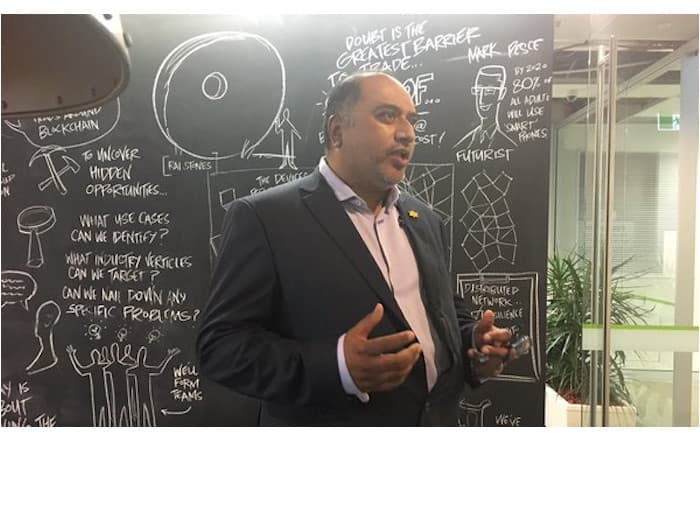
You wipe your sweaty palms once again on your designer jeans, your slightly irregular pulse quickens and it's getting a little difficult to think clearly. The room seems to be getting warmer, the audience which not so long ago full of pleasant idealists now seems a mixture of the indifferent and hostile.
The current presenter seems to be struggling and his presentation is going awry. Your stomach tightens into a fist as he finishes weakly with a punchline that sags under its own weight. You look around at your team-mates and they are all looking at you with hope and trust in their eyes as you carry the burden and responsibility of all their efforts on your shoulders.
It's time to go on. It's time for the show to start. It's time for your pitch.
"All great speakers were bad speakers at first."
— Ralph Waldo Emerson
I was fortunate to attend a Watson Health focused event in San Francisco and met many wonderful entrepreneurs a day before they pitched their solutions to executives. I spent most part of an hour with a young, passionate and talented team talking about their solution and how to refine their pitch, drawing more upon their own authenticity and emotion.
Pitching is part of life - something we all do every day. It's a part of communication, of positioning, of conversing, to present, to seal the deal, to elaborate or maybe even to discombobulate. I believe that regardless of the environment we're working in, it's a skill that we should continually take the time to refine with practice and experimentation.
Storytelling
There is nothing like starting with a story to get even the most cynical audience to open their minds, lean forward and listen to what's about to be said. I think we're conditioned from birth to look forward and open up and be inspired by stories.
"People have forgotten how to tell a story. Stories don't have a middle or end anymore. They usually have a beginning that never stops beginning."
— Steven Spielberg
Stories often follow a structure so think about that when you tell yours - who is the protagonist, what is your introduction, what is the quest, how will you build to a climax, will you introduce some twists and will there be a happy ending?
Design Thinking
Today's Designers and Creatives use techniques such as creating stories using personas, empathy maps, journey maps and a host of other techniques to better understand the problem that needs to be solved, the users and stakeholders that it impacts and how to design solutions to meet their real and often unstated needs.
Using these techniques can give you greater insights and help you better understand the customers you're going after and what drives them - not just their stated questions and concerns. The background information you gather can help you better prepare for your pitch and provide a colourful and critical set of information you can draw upon to make your pitch more compelling.
Emotion
People often buy because of emotional rather than logical factors. So look for a way to also connect to your audience and bring them on an emotional journey as well.
"When dealing with people remember you are not dealing with creatures of logic but creatures of emotion."
— Dale Carnegie
How can you bring emotions such as curiosity, attraction, hope, joy, relief, sympathy, pride or love to your pitch? Perhaps it's important to bring alarm, disgust, fear, anger, frustration, sorrow, remorse to the discussion? The intention is not to polarise the audience but to bring the appropriate gravity and emotion to the topic at hand.
The Pyramid Principle
Having a logical structure to your pitch that people can follow is an invaluable pitching tool. Otherwise, this can leave the audience confused as they spend time and effort working through that confusion rather than spending their entire attention on your pitch.
The Minto Method, used by many consultants the world over, helps with many forms of communication. The approach is to look at the introduction (something the audience knows), complexity (some insight that compels the audience to look at the problem in a different way), and a solution which typically follows the structure of a pyramid.
Business Model Canvas
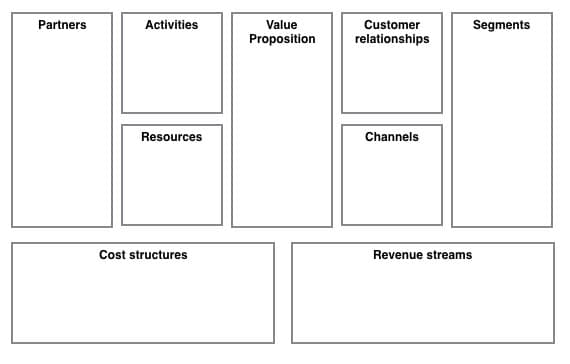
Tools such as Business Model Canvas are now commonly used by the Lean Startup movement around the world. They provide a quick and to-the-point method to describe your problem and solution and the hypotheses you have made against each of the key domains. They are great ways to think through key domains of your solution and provide key background material to a pitch - business partners, value proposition, resources, cost, revenue etc.
Passion
I want to believe! I want to buy from those that believe in their products. I want to see that the speaker is excited about their topic because if they're not passionate - I'm likely to follow suit and not be convinced or interested.
"There is no passion to be found playing small - in settling for a life that is less than the one you are capable of living."
— Nelson Mandela
Slides
A major problem with presentation slides is that they are often treated as the primary vehicle for communication rather than the presenter himself. As a consequence presenters overtly rely on the presentation slides to perform an impossible role.
My favourite pitches are often where no slides are used at all and all focus is on the presenter. If that is not possible then a pitch using images rather than text has its place.
I'm always looking for creative ways to capture the audience's imagination. In the past for example, I've created decks simply filled with chalk drawings that engage the audience as a backdrop to topics in hand.
The Importance of the Pause
With only a short period of time it can be easy to talk faster and fill all available space. However, humans need space and time to understand and digest concepts. A pitch with many new concepts can easily leave the audience behind grappling to catch up or miss important points.
Space can be used for emphasis and dramatic effect or to prompt the audience to ask a question. Look to say less, focusing on key points and allow the audience the time to follow you. The pause.... is.... important.
Summary
The perfect pitch does not come easy. Searching for the perfect pitch leads you to a lifetime of learning and practice. I hope the techniques, experiences and suggestions listed above will help you in your own journey - taking you from one that is perhaps a little tone deaf to being able to perform an orchestral movement that inspires others.
Your five minutes of fame are over and the bell rings just as you finish your last point with your call to action resonating in the hearts and minds of your audience. You watch the audience pause, reflect and connect the logical stepping stones you left with the emotional outcome you desired.
You smile. You are confident and satisfied in that brief stillness, where the audience complete the metaphorical journey to your side. You watch and listen to that stillness that's soon overtaken by rapturous applause.
You know. You know. You've just delivered the perfect pitch.
Originally published on LinkedIn:
Pitch Perfect - The Art and Science of Pitching - LinkedIn PulseVinod Ralh
Enterprise & Solution Architecture | Architecture Governance & AI Strategy